

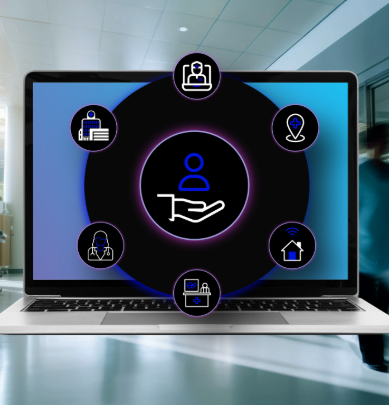
Integrated digital healthcare and continuity of care
The digital transformation of healthcare is not simply about adopting new technologies, but about the ability to build truly integrated care models. Today, patients move through different settings—home, community, and hospitals—that often do not communicate with one another. This leads to fragmentation, redundancy, and a loss of clinical value. Advanced digital healthcare platforms are designed to resolve this discontinuity by creating a collaborative ecosystem in which data, professionals, and processes are connected in a structured, secure, and governed manner.
“True innovation arises when systems stop being isolated entities and become networks.”
Digital Health Vision
From fragmented systems to a single ecosystem
In recent years, the healthcare system has faced increasing organizational complexity. The rise in chronic conditions, an aging population, and the need to strengthen community-based care have highlighted the limitations of traditional models. Without a platform capable of coordinating care pathways, healthcare professionals work with incomplete information, and patients risk not receiving continuous and consistent care.

The text is clean and simple, with a comfortable layout. The border is transparent. The background is light gray. The text is light gray with a clean, straight border. The text is light gray, with a border that is slightly curved, and the edge is light gray. The text is light gray, with a border that is slightly curved, and the edge is light gray. The rhombus was a phasellus. The vel eros vitae is an aliquet pellentesque vitae et nunc. But the leo will prepare and submit your vitae nisl pellentesque semper.
Insights into Digital Health
- How to Build Truly Integrated Models of Continuity of Care
- The Role of Interoperability in Complex Healthcare Systems
- Why data governance is central to digital health